No more posts from me for 2 WHOLE WEEKS!!! I am officially on vacation. See everyone soon!
Example of Using Video for Library Events
 I’m still experimenting with video, as you can see here. This was taken today, at my library’s First Fridays event. This month, we had a band performing on the stairs to our way-cool library parking garage. We also had free hotdogs and an information booth! It was fun (if you’re interested, I took some photos, too).
So… here’s an example of a video snippet taken of a library event. This snippet (assuming it’s good enough for the average joe – I’m no Steven Spielberg) can be used to showcase library events, future First Friday events, etc. If a library has a blog and/or an RSS feed, the video can be sent to patrons – what a great way to get the word out about cool library events!
And it’s done in more of a “story” format, rather than in a formal, “look we paid lots of money for a TV spot” style, which seems to be nicer for the web. The video briefly tells the “story” of the First Fridays event, and provides viewable snippets of the event at the same time.
Time spent on this? Let’s see… 45 minutes of actual video shooting (including time spent eating a hot dog). 1-2 hours of downloading, editing, and exporting to Quicktime. And that’s because I’m not used to it yet – it would be faster if … well … I was faster. And then the time it took me to upload the video to blip.tv and write this blog post.
Any thoughts?
I am a portal…
Yesterday, I taught another one of my Introduction to Web 2.0 classes – this time at the Missouri Public Library Director’s meeting. There were about 50-60 library directors there, which was pretty cool!
Afterwards, they asked some great questions. One of their questions really puzzled me at first – someone asked me to explain the difference between a portal and an RSS feed. Really. I said something about how a portal is really just a large website with lots of links on the main page, and how an RSS feed isn’t anything like that at all – but still wasn’t really satisfied by my answer.
So as I was driving back to Kansas City, I was mulling it over… and here’s what I came up with.
Anyone remember Netscape’s front page from, say, about 1999? It was a portal site – lots of links, and the page pulled up information from different sources – reuters, stock information, sports stuff, etc – and stuck it all on that single page. I think you could even customize it a little bit. Pretty cool for the time.
Even though it was customizable, it couldn’t REALLY do all I wanted it to do. It couldn’t, for example, pull up the list of new fantasy novels at the local public library. It couldn’t deliver just the news I was interested in. So there were some definite limitations.
As I was thinking about that library director’s question, and was remembering all that stuff about portals … it dawned on me just how excellent of a question that really was. Because, with RSS:
I am the portal
And that’s a huge shift. In 1999, I had to rely on a company to gather the information they thought I might want. But today, with RSS, I don’t have to rely on said company. I can, instead, rely on MYSELF to gather whatever it is I want.
I can get the information I want, when I want it.
So now I have my answer (not that it’ll ever come up again :-).
Anyone else have creative, useful answers to questions about emerging digital technology? I’d love to see them.
Thinking about MySpace and other Free Third-Party Services
I have a MySpace account. I have signed up, posted a blog, and started gathering friends. I even uploaded a video. It’s sorta cool, and I can see the networking opportunities in it for people. And I can also see how a library could use this type of social networking service to post events, get out info on new materials, etc.
But I do have one observation to make. When setting up a free account in something like MySpace that runs on ad revenue, a library needs to consider the ramifications of what their customers might see (and then click on, thinking it’s from the library).
Here are some examples:
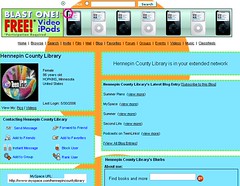
Woo hoo! The library’s giving away FREE iPODS!!!
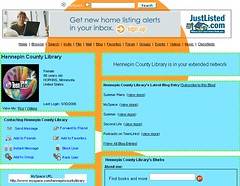
Wow – the library MUST think this new realtor site is useful, because they’re advertising it on their site…
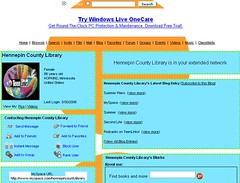
Great – my computer is having problems, and the library is recommending this computer repair service…
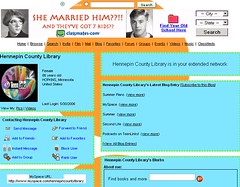
Sorry – this one’s for comic relief… those two people in the Classmates ad have to be THE MOST FAMOUS FACES ON THE WEB…
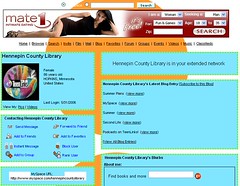
Not for comic relief – especially when a parent calls with a complaint because their child just ended up at that intimate dating online service that your library just offered him/her for free… OK – get my point?
Am I saying that free things like MySpace, Flickr, Blogs, Wikis, etc are bad? No way! But I am saying that these new services need to fit into your library’s plan… don’t just set one up to “see what happens” or “just for kicks.” Think through a few things first:
- What does your library plan to offer using this new service?
- What are the library’s goals for establishing this new service?
- Can the advertising be minimized by paying a fee or by choosing certain categories?
- Does the service meet the library’s strategic goals?
- Who’s going to maintain this new service?
- And most important: if it’s successful – what’s next?
If you answer some of these questions early on, you’ll be prepared – prepared to fully offer services using this new environment; and prepared when someone DOES call because they didn’t understand it really wasn’t your library offering those free iPods… ahem…
Gaming in Academia
I read this article on the Duke University website a few weeks ago, and was intrigued by what was said about incorporating gaming into the classroom. The article talked about the Center for Instructional Technology Showcase that was held on April 27, and I found the plenary session, titled “Serious Games: Digital Game-Based Learning in Higher Education” to be interesting. Here are some quotes from the article:
“If we [academics] can immerse students in an interactive story or narrative, they’re motivated to work through problems and will retain material more effectively than if they’re passively taking notes in class.”
“State of the art 3-D graphics create the post-apocalyptic game environment used in Sarbaum’s Econ 201, an introductory economics course he will teach this coming fall at UNC-Greensboro. The game will take the place of a standard introductory economics course. In it, students play characters in a game involving aliens who have crash landed, and have to use economic principles to survive. In the course of doing so, they develop a society and engage in daily struggles of supply and demand.”
“The hope is that by identifying with characters, the learning will stick.”
That’s certainly one way to make an Econ class more interesting, huh? But here’s the deal – I can see the characters in the game needing to gather information, needing to do research in order to attain a goal in the game/class… and where might that information come from? I think it can come from librarians!
If the library works with the professor developing the class, the librarian can be the strategy guide in the game, helping the gamers/students attain information needed to attain goals (translation – get a good grade!).
Makes you think…
- « Previous Page
- 1
- …
- 261
- 262
- 263
- 264
- 265
- …
- 327
- Next Page »