I was just on TV this morning at Fox 4 News in Kansas City, doing a 3-minute segment about my book, Face2face: Using Facebook, Twitter, and other Social Media Tools to Make Great Customer Connections. It was fun! Here’s my bit:
Enjoy!
social media | emerging trends | libraries
I was just on TV this morning at Fox 4 News in Kansas City, doing a 3-minute segment about my book, Face2face: Using Facebook, Twitter, and other Social Media Tools to Make Great Customer Connections. It was fun! Here’s my bit:
Enjoy!
 Once in awhile, some of you guys ask me questions via email. Usually, I just answer back in another email. This time, I thought I’d also answer via a blog post – you might find something useful here, too.
The question was about social media – how does your library do it, how is it used, who manages it, etc. Here are the questions and my answers:
1. Should social media responsibilities fall within the scope of public relations and marketing? Who in your library has the responsibility?
In Topeka, our Digital Services Director (that’s me) has oversight of social media. He acts as our library’s digital branch manager. That said, social media is a shared responsibility. Usually, a social media push starts in our Creative Group – a team made up of web, marketing, and public services staff. This team gets a feel for a new service, sets some preliminary goals, and sets up the service for the library. The next step for us is to create a pilot project team made up of public services staff (and the digital services director and possibly a marketing staff member too).
Then we expand as needed. For example, our Facebook team includes 12-15 staff members, mostly public services staff.
2. Is your website managed within your IT department?
Our IT department is part of our digital branch. IT is under the direction of the digital services director. Our web developer and web designer are both part of the IT department, and also part of the Creative Group. They do all the back end development of the site. Most of the content on our website is developed and maintained by other staff in the library (usually public services staff). The digital services director sometimes edits content, and meets with staff to help provide general suggestions and direction for library content. Marketing also helps with this.
3. How do you use social media and your website to engage with your communities?
We use social media to connect with our community by sharing library stuff and staff. “Stuff” includes our materials, events, and services. “Staff” means just what it sounds like – our staff involved in social media work to engage our community. For example, on our Facebook Page, our Facebook team focuses on these areas: readers advisory, current events and trends, and library materials, events, and services. In every post, our goal is to connect and engage with customers (in Facebook, the more engagement you get, the more eyes see your post), to point back to the library, to answer questions as they occur, and to share the library with our online community.
4. How much control of message and brand is important, in contrast with community engagement on the part of many staff throughout your library system?
I can’t say this strongly enough – in social media, you simply cannot control the message. Your customers do. Most modern marketing books, websites, blogs, etc. say that social media is all about engagement. It is probably 90% customer engagement and conversation, and only 10% marketing. If you flip that ratio to 100% marketing, your followers will simply tune you out.
Think about social media like this – who sits at your reference desk? Who runs your programs, classes, and events? The marketing department, or front-line public services staff? Does your marketing department control and edit the conversations taking place at the reference desk? I’m guessing not.
Social media is the same – it’s customer conversations and engagement, just like in your physical buildings. It’s just happening in your “digital building” – on your website and in your social media accounts.
photo by Mixy
Maureen Sullivan, ALA president, just posted an Open Letter to America’s Publishers. Go read it, then come back and discuss.
On the one hand, it’s a fine letter, addressing all the appropriate stuff. On the other hand … I think I’m confused. Here’s why:
The letter doesn’t really seem to be addressed to America’s Publishers. Instead, it seems to be addressed to libraries and librarians. Most of the letter gives the normal “aren’t libraries awesome” stuff.
And then, in the last two paragraphs, that’s when the letter actually gets to the point. Here’s our big call to action:
“We librarians cannot stand by and do nothing while some publishers deepen the digital divide. We cannot wait passively while some publishers deny access to our cultural record. We must speak out on behalf of today’s — and tomorrow’s — readers.The library community demands meaningful change and creative solutions that serve libraries and our readers who rightfully expect the same access to e-books as they have to printed books.â€
“So, which side will you be on? Will you join us in a future of liberating literature for all? Libraries stand with readers, thinkers, writers, dreamers and inventors. Books and knowledge — in all their forms — are essential. Access to them must not be denied.â€
Did I miss something? Our big directive from ALA is this:
??? All Maureen/ALA is asking libraries to do is to … “speak out???†Nothing about the issues, nothing about results, nothing about concerted efforts…
So really – I’m glad maureen is ALA president, and I’m glad ALA is starting to do something about ebooks. But I’m not sure that simply asking libraries to randomly “speak out†about the issue is useful.
Why not something more concrete, like “everyone call Penguin on October 1 at 2pm, and ask for the same thing”? And then provide some some talking points to use during the phone call?
How about something more specific saying what ALA is doing about the issue, and giving us something to take back to our library boards?
Help me out here – what could we as libraries and librarians do that is more than just “speaking out?” Let’s create some better, more specific next steps for ALA. I think we can do better than this!
 I was just interviewed about my new book (Face2face: using Facebook, Twitter, and other social media tools to create great customer connections) for the SitePoint podcast. Patrick O’Keefe (@ifroggy on Twitter) did the interview, and we talked about digital media in the modern library and (of course) connecting with customers and visitors via online social tools.
Here’s a link to the interview (and an embedded tweet version of the link below):
SitePoint Podcast #180: Face2Face with David Lee King ow.ly/2sjews
— SitePoint (@sitepointdotcom) September 21, 2012
Anyway – you might find it an interesting listen … so take a listen!
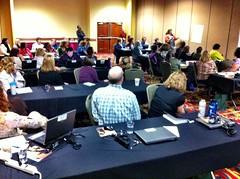 Michael Porter and I recently gave a 3-hour workshop on the econtent landscape at the Montana State Library Fall Workshop. During the workshop, we divided participants into groups, and asked them to do some brainstorming on three questions.
I posted the whole list of responses over at the Library Renewal blog (I’m a board member for Library Renewal), but I’m going to highlight a few responses here:
1. What do you want with ebooks?
DLK’s commentary: Honestly, we aren’t asking for much, and it’s all do-able. For example – Hachette’s recent price hike? At least they didn’t cut access. In the business world, that means they want to play – now, we just need to settle on a fair price. Now we just need Hachette’s frontlist titles, and we need Penguin, MacMillan, and Simon & Schuster to play along, too. Interface stuff – the fairly standard ePub format is out there … we just need Amazon to add it to the Kindle.
Marketing – that’s 100% us, guys. Want your customers to know you have ebooks? You HAVE TO TELL THEM. If Pew Internet is reporting that 58% of our library card holders don’t know if we have ebooks, then we either didn’t tell them, or we made a poor attempt at telling them. Let’s get this one right, ok?
2. What is realistic for your organization?
DLK’s Commentary: Lots of good ideas here. One good way to tackle pricing, especially for all the small, rural libraries in Montana, is via some type of consortium pricing model. And again, we can do something about marketing and about education. These are all definitely very do-able and realistic.
3. What can you do to make what’s realistic actually happen?
DLK’s Commentary: I love the idea of getting  local and state reps educated and involved in our current econtent access and funding issues. We might not be able to do much nationally, but I wonder if we could start something locally or statewide, and then get that moved up to a national level?
Also, working locally with small, local publishers, or even authors, is a great way to start, too.
What’s missing here?