This was my session – here are my slides – enjoy! Look at the slides, and read this person’s notes, and you will get a good feel for the discussion.
Social Media Strategy & Goals
View more presentations from David King
social media | emerging trends | libraries
This was my session – here are my slides – enjoy! Look at the slides, and read this person’s notes, and you will get a good feel for the discussion.
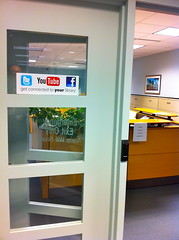
You’ve seen those “follow us on Facebook” signs at stores and restaurants, right? Or heard a radio dj mention following their radio station’s Twitter account on-air?
Guess what? Libraries can do the same thing!
As a first experiment, my library recently placed two “follow us” signs in our building – one at the main entrance to the library, and one on our administrative office doors (shown in the photo).
Why do this? Easy – it’s a relatively unobtrusive way to tell our customers that we have a social media presence, and that we want them to follow us. It’s also a way to link the physical to the digital – by promoting our digital presence (i.e., our Facebook Page) in our physical presence (i.e., our building).
Where else could we put these signs?
One thing we can improve on – Kathryn Greenhill mentioned this to me recently – when you make a sign advertising your social media presence, make sure to include a URL or at least your social media name. Otherwise, people might not be able to find you (we were talking about this particular sign)! For example, my library’s full name is Topeka & Shawnee County Public Library … but we’re simply topekalibrary on social media sites. We’ll add that on the next version of the signs.
And a funny – watch the arrangement of your icons! We almost put the Facebook icon first … until someone in our Creative Group mentioned that we were spelling “F You[tube].” Certainly not our intent to tell customers to “F You!”
Like these ideas? Come hear more on November 2 at my ALA Techsource webinar on Facebook Pages! Make sure to register!

Wouldn’t it be weird if Google, KS blocked Google from their own computers?
Unfortunately, that just happened.
OK – it’s really Topeka, KS (Topeka renamed the city for that Google Fiber project). And they didn’t really block Google – they blocked Youtube (which Google owns).
But still – there’s some irony there, is there not?
Go read this newspaper article, City tightens control of employee Internet use. Then come back here, and let’s discuss.
Here’s what I find odd about the city’s recent decision to block staff access to social media sites:
Oddity #1:
“City spokesman David Bevens said the city prohibits employees from using their work computers to access YouTube, as well as the Facebook and Twitter social media sites, but some employees have nevertheless accessed YouTube on those computers … “
That’s got nothing to do with social media, and everything to do with employee performance. That’s sorta like saying “obesity has become a health issue at our organization, so we blocked employee lunches.” In other words, the city is dealing with the symptom, rather than with the real problem – in this case, employee performance. Blocking Youtube won’t fix that problem, I’m afraid.
Oddity #2:
“Stanley [interim city manager] said he was disappointed to learn the problem was directly related to the perceived need by some employees to access popular social media websites, such as YouTube and Facebook.”
It’s more than a “perceived need” – the city actually has official Youtube, Twitter, Flickr, and Facebook accounts. So yeah – “some staff” definitely DO need access to those sites, to do actual work.
And since those social media sites are essentially official city channels, I’d go so far as to say all city employees need access to them. At work. Otherwise, the city is blocking official city communications … from city employees. Nicely done, Google, KS!
Oddity #3:
IT manager Mark Biswell is quoted as saying this: “While these websites have value in terms of information transfer and marketing, they also pose an organizational risk in terms of lost productivity and through the potential introduction of viruses and worms … “
First off, let’s deal with that perceived “lost productivity” thing. Recent studies actually show that employees have increased productivity if they have access to social media. Want more productive employees? Give em access to Facebook and Youtube.
Second, that virus and worms thing. Social media sites like Facebook and Youtube don’t become popular if they’re sending out tons of viruses – instead, they get sued (thanks for that thought, @billludwig!). I sincerely hope that most IT managers know that “viruses and worms” generally don’t come from social media sites like Youtube or Facebook. They come from spoofed sites, rogue links in forwarded emails … and from uneducated staff. A better way to approach computer security would be to 1. unblock Facebook and Youtube, and 2. Train staff on appropriate use of web technology, and how to NOT click on those weird links or ads.
Oddity #4:
One last thing. The IT manager is also quoted as saying this: “Biswell said that to balance risks with the informational value of using such sites, the city was taking a proactive approach by cataloguing and safely providing employees access to YouTube videos that have business value related to training and education … The approach is the same one used by educational institutions, he said.”
That’s because the people at “educational institutions” are, for the most part, kids. Don’t treat your adult employees like kids. ‘Nuff said.
So why write this?
Thankfully, I don’t work at a city library, so I haven’t had to deal with this. But some of you librarians have dealt with this, head on. Library Directors – don’t let this happen to you! At least be informed, so you can intelligently argue your points to city administrators, city IT managers, or a city attorney. I’d love to hear from some libraries who successfully argued their points, and were able to keep or get library access to social media sites.
In other news, on Friday I tweeted a question to the City via their official Twitter channel, asking them how they were going to respond to my question, since they are now blocked from using Twitter.
Still no Twitter reply. I wonder why?
I recently gave this presentation at ALA11 and at the Virtual ALA11 conference, along with Kolene Allen who focused on Twitter. Both sessions went well … and someone has been asking me to post my slides! So here they are:
In my part of the presentation, I talked about what libraries can do with Facebook Pages, and why they might want to use Facebook Pages to reach out to customers.
If you’re interested, this fall (November 2) I’ll be doing a 90-minute version of this, through the great ALA Techsource webinars – stay tuned for that later on this year!
 Google Plus is all the rage this week – invites have started spreading around (here’s a link to my Google Plus account – feel free to friend me!).
Some tech leaders have been making big claims about Google Plus, saying things like it will replace blogging, they’re moving from Facebook to Google Plus, it will take over Facebook or Twitter, etc.
Ok … Google Plus is only a week or so old. WAY too early to predict the demise of anything – especially of something like Facebook, with its 600 gazillion followers. Also remember that this is a third try for Google – Waves and Buzz both sorta fizzled out. let’s give it a good 6 months to a year to see if it survives.
On to the more important questions – should YOU be using Google Plus? Should your Library/organization?
You – this one’s easy. If you get an invite (or have an account already), by all means sign up and play around with it. Friend people, do some posting, try a video chat. Get familiar with the tool. Then either use it or not … that part really depends on you. But since it has some early potential in becoming another useful social media tool … why not at least play with it a bit?
Your library/organization – this one’s a bit more tricky. Or not – Google Plus isn’t supporting organizational accounts right now, according to this article from Search Engine Land. This article from ReelSEO goes one further, saying Google Plus will shut down an organizational account (though there are a couple out there [DLK -Â oops. Google found those, and they’re now 404-nothing found pages. You might check this out for some news orgs, from Moonflowerdragon in my comments]Â anyway).
So for the time being anyway, Google Plus is an individual-only network. That’s great, because it gives you time to play with the new tool, and gives Google time to see if it’s a winner (translation = profitable) for them.
Once that happens, and Google OKs organizational accounts – should you be there? The answer is … it depends. Are your users there? If so, then yes. Recent national stats claim that 51% of people age 12 and up are on Facebook – that’s 51% of your community, so it definitely makes sense for most libraries and organizations to have a Facebook presence.
But for other social networks, it really depends on your organization’s goals, and on where your customers tend to gather. If they start gathering in Google Plus, then yes – you should figure it out and be there for them.
If not? Maybe not so much. Time will tell!
And a question – are you playing with Google Plus? If so – what do you like/dislike about the service? Let me know in the comments!